We'll Make It Work
Our Differentiators
The Promise Behind Our Name
At Plastic Molding Development, "We'll Make It Work" isn't just a slogan. It's how we approach every project.
For 35 years, we've built our reputation on solving the problems other shops walk away from. Difficult mold. Tight timeline. A tryout that isn't cooperating. That's when a customer needs a partner who says "let's figure it out" instead of "that's not what we do."
Open Press Time When You Need It
Engineering programs run on tight timelines. When a mold needs to be sampled before a design review, or a production part fails inspection, waiting weeks for press time isn't an option.
We keep open press capacity across our 10 machines so customers can get in quickly, run their tryout, and get back on schedule. Same-week tryouts, short-notice validation runs, or scheduled iterations — our team works to make it fit.

A Shop Floor Built for Collaboration
Some projects need the customer in the building. A tool maker who wants to see the mold run. An engineer making real-time decisions about cycle time. A quality lead reviewing first-shot parts.
Customers and their teams are welcome on the shop floor during tryouts, working directly with our process technicians as adjustments are made. Decisions that would take a week of emails happen in minutes when everyone's standing at the press together. Most of our customers are regulars, and they treat the shop like home.
Machines and Cranes for the Toughest Jobs
Handling large or complex molds isn't just about press tonnage. It's about everything around the press.
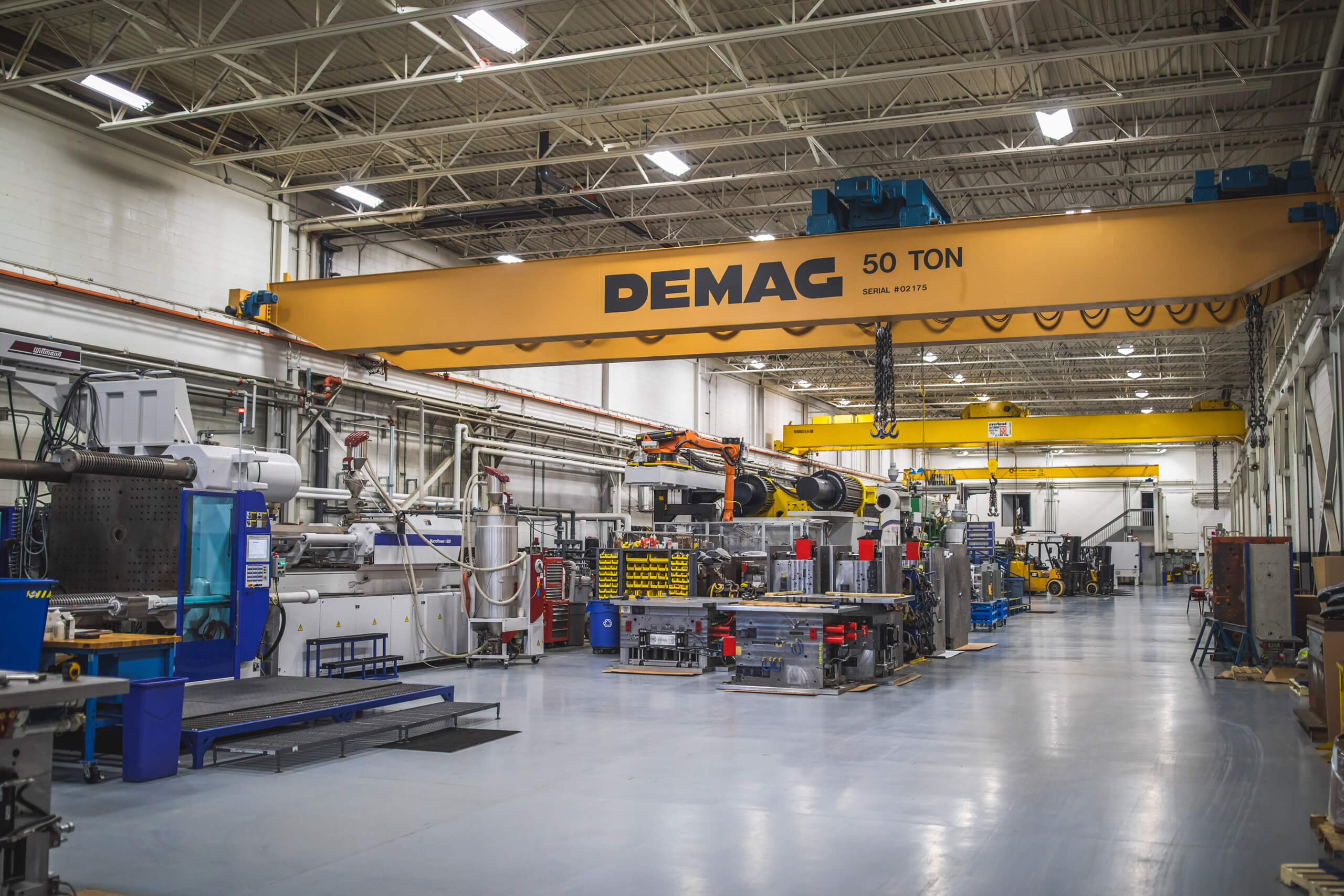
Our 35,000-square-foot Sterling Heights facility runs 10- to 40-ton overhead cranes for moving heavy tools in and out of the presses. Our team handles set-up, mold loading, and tear-down so your tooling stays protected. Van Dorn presses up to 3,300 tons and Wittmann Battenfeld machines with 4-axis and 5-axis Cartesian robots let us match the right setup to the project.
35 Years of Global Experience
You can't build "we'll make it work" overnight. It comes from decades of running molds and solving problems.
PMD has operated in Sterling Heights since 1985. Many of our press operators and process technicians have been with the company for 20 years or more. Cycle time issues, warpage, short shots, gate freeze — our team troubleshoots these in real time and gets molds producing acceptable parts faster than a less-experienced shop could. That's the value 35 years buys you.
Ready to Put Us to Work?
Whether your project is a straightforward tryout or a mold nobody else can figure out, we're ready to help.
Frequently Asked Questions
Questions About Mold Tryouts
What is a mold tryout, and why do I need one?
A mold tryout is the first time a new or modified mold gets tested on a press to see how it actually runs. Even a well-designed mold can have issues once real plastic starts flowing through it, and tryouts catch those problems early. At PMD, we run the mold, evaluate the parts, and work with you to make adjustments before the tool goes into full production. It's a lot cheaper to fix a mold at tryout than after your production line is running. Learn more about our tryout process.
How is a mold tryout different from a mold run-off?
They're related but not the same. A tryout is usually the earlier stage, focused on confirming the mold moves correctly, fills the cavity, and produces parts that look right. A run-off happens later, once the mold is closer to production-ready, and it's meant to prove the mold can run consistently over a longer sample. Some customers use the terms interchangeably. Whatever you call it, PMD supports both, and we'll match the process to what your program actually needs.
Do you handle T0, T1, and T2 samples?
Yes. PMD runs first-shot samples (sometimes called T0), initial customer samples (T1), and follow-up trials (T2) after mold corrections. Each stage has its own goals: T0 confirms the mold works, T1 checks dimensional accuracy and surface quality, T2 verifies the corrections held. If your program requires specific documentation for any of these stages, let our sales team know at the start of the project.
Can I be on-site during my mold tryout?
Yes, and we encourage it. Some of the best tryouts happen when the customer's engineer, tool maker, or quality lead is at the press with our technicians. Decisions that would take a week of emails happen in minutes when you're standing there watching parts come off the machine. We also have a customer lounge for the time between shots. Just let us know you're coming so we can plan the day.
Do you build the mold, or do we bring our own tooling?
You bring the tooling, and we run it. PMD is a tryout and short-run production shop, not a mold builder. Most of our customers work with a tool and die maker (or an in-house tool shop) to build the mold, then send it to PMD for tryouts, validation, and short-run production. If you're not sure how PMD fits into your project, our sales team can walk you through the process. Learn more about our services or contact us to talk through your project.
Questions About Our Open Press Time and Scheduling
What does "open press time" mean?
Open press time is availability we hold across our 10 machines so customers can book a tryout without waiting weeks. When a mold shows up unexpectedly, or a program needs a fast turn on a validation run, having open press time means the tryout can happen this week instead of next month. It's one of the reasons Tier 1 suppliers and tool makers work with PMD when their schedules get tight.
How quickly can I get my mold on a press?
That depends on the machine size you need and what's already booked, but same-week and next-week tryouts happen often. If your program is on a tight deadline, call our team early so we can talk through options. The more notice we have, the more flexibility we have. Contact us to check current availability.
Do you take short-notice or rush tryouts?
Yes, when press capacity allows. We understand that mold arrivals and program deadlines don't always line up neatly, so we work to fit rush jobs in when we can. Reach out and we'll tell you honestly what's possible.
Questions About Our Short-Run and Low-Volume Production
What counts as a short run at PMD?
Short-run production usually means anywhere from a few hundred parts up to about 10,000, though the exact fit depends on the part and the material. Short runs are a good fit for prototypes, bridge production (parts you need before your production tooling is ready), or low-volume products where a full production run doesn't make sense. If you're not sure whether your project fits, our sales team can help you figure it out.
Is there a minimum order quantity?
We don't publish a strict minimum because it depends on the project. Very small quantities are possible, but for jobs under a few hundred parts, the setup cost per part gets high. If your quantity is on the low side, talk to our team about whether short-run makes sense or whether another approach fits better.
Questions About Our Machines and Capabilities
What tonnage range do you offer?
Our 10 machines run from 170 tons up to 3,300 tons. That covers everything from small precision parts to large automotive components like fascias and instrument panels. For projects that need automation, several of our presses are paired with 4-axis or 5-axis Cartesian robots or KUKA articulated robot integration.
Can you handle large or heavy molds?
Yes. Our 35,000-square-foot Sterling Heights facility runs 10- to 40-ton overhead cranes for moving heavy tooling in and out of the presses. Our team handles set-up, loading, and tear-down, so your mold is protected throughout the process. If you're planning a job with a large tool, let us know the weight and dimensions when you reach out.
What plastic materials do you work with?
We run a wide range of thermoplastics on our machines, including common resins like polypropylene, polyethylene, ABS, polycarbonate, and nylon, along with engineering-grade materials like glass-filled nylon, PBT, and other specialty resins used in automotive and industrial applications. If your project calls for a specific material or a custom resin blend, let our sales team know so we can confirm it fits our equipment and process.
Contact us to discuss materials for your project.
Questions About Our Confidentiality
How do you protect proprietary designs and tooling?
Many of our customers work on pre-production designs, competitive programs, or projects with tight confidentiality requirements. We manage each project with strict operational controls: siloed workflows, restricted access to project files, and NDAs when the project requires one. Your tooling, drawings, and part designs stay protected throughout the tryout and production process. Learn more about our approach to quality and confidentiality.